NEP 2020 Smart Classroom AV Guide — Interactive Displays for Indian Schools and Universities
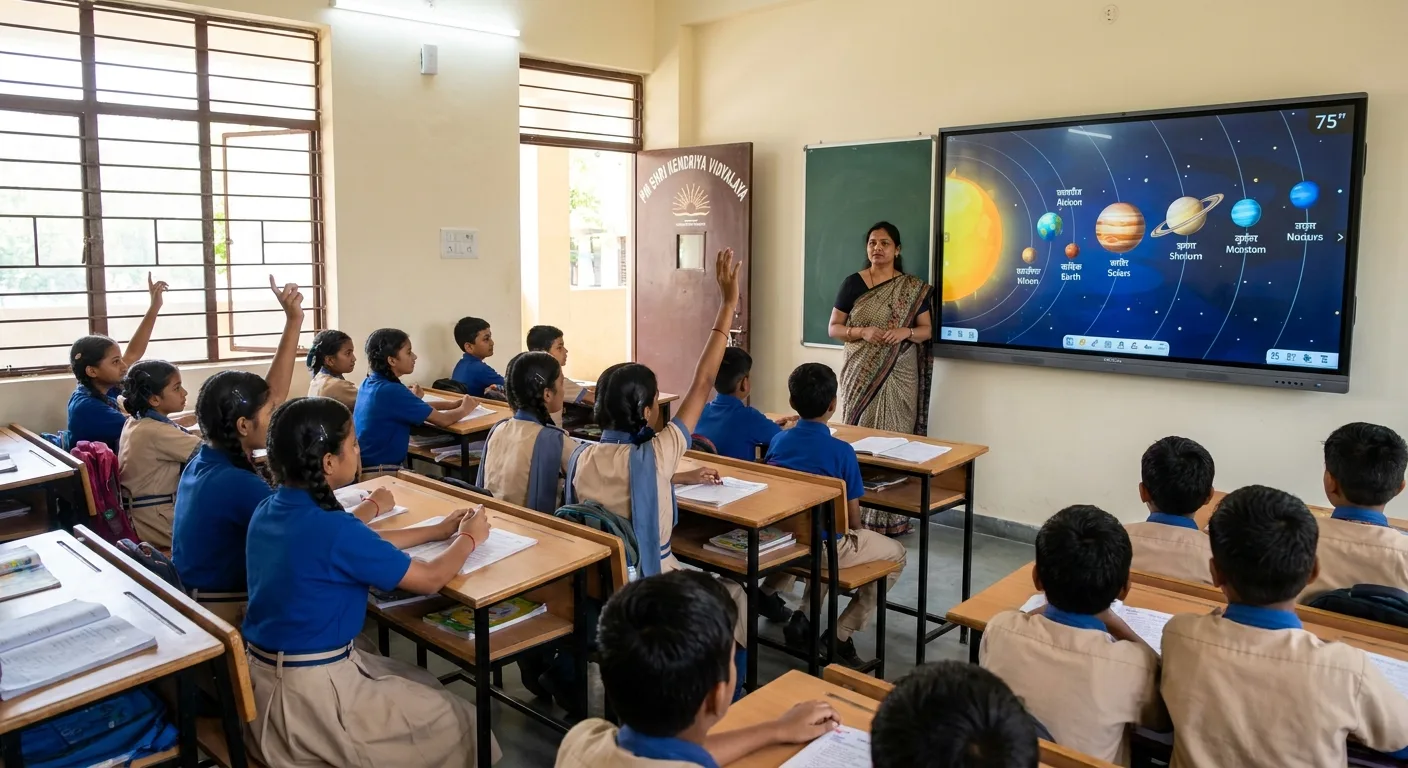
The National Education Policy 2020 (NEP 2020) is the most significant overhaul of India's education framework in over three decades. Among its many provisions, NEP 2020 explicitly calls for the integration of technology into classroom teaching at every level — from primary schools to universities. Interactive flat panel displays (IFPDs) have emerged as the centrepiece technology for this transformation, replacing projectors, traditional whiteboards, and chalk-and-talk instruction with interactive, multimedia-rich, collaborative teaching tools.
State governments across India — Karnataka, Maharashtra, Tamil Nadu, Andhra Pradesh, Uttar Pradesh, Rajasthan, and many others — are rolling out smart classroom programmes under NEP 2020 mandates. Central government institutions, Kendriya Vidyalayas (KVs), Navodaya Vidyalayas (JNVs), and CBSE-affiliated private schools are all procuring IFPDs in large volumes. This guide provides a comprehensive, practical resource for school administrators, procurement teams, and AV integrators involved in smart classroom deployments under NEP 2020.
What NEP 2020 Requires for Smart Classrooms
NEP 2020 does not prescribe specific products or brands, but it establishes clear directives around technology in education. Section 23 of the policy emphasises that “technology will be used for better data management, teaching-learning processes, assessment, and administration.” The policy envisions every classroom having access to digital content, interactive teaching tools, and connectivity to national educational platforms like DIKSHA, SWAYAM, and the National Digital Education Architecture (NDEAR).
At the implementation level, the Ministry of Education's PM-SHRI (PM Schools for Rising India) scheme — launched to upgrade 14,500 schools across India — explicitly includes smart classroom technology as a core component. State-level implementations vary, but the common thread is clear: every upgraded classroom needs an interactive display that can access digital content, enable collaborative learning, and support blended (in-person plus online) teaching modes.
The practical requirement translates to: an interactive flat panel display with touch capability, built-in computing (OPS or equivalent), pre-loaded or accessible educational software, internet connectivity, and the ability to display content from USB drives, laptops, and cloud platforms. This is exactly what modern IFPDs from MAXHUB and Samsung deliver.
State-Level Smart Classroom Initiatives
Multiple states are running dedicated smart classroom programmes: Karnataka's “SMART Classroom” initiative targets government schools across all districts; Tamil Nadu's “Hi-Tech Classrooms” programme covers higher secondary schools; Andhra Pradesh's “Digital Classrooms” project has deployed interactive displays in thousands of government schools; and Rajasthan's “Smart Class” programme targets schools in rural and semi-urban areas. These programmes procure IFPDs through state-level tenders and the Government e-Marketplace (GeM), creating consistent demand for authorized, warranty-backed interactive display products.
Why IFPD Replaced Projectors in Classrooms
Until 2018-2019, the standard smart classroom setup in India was a projector and screen, typically combined with a wall-mounted whiteboard and an external speaker system. This setup had fundamental limitations that IFPDs have resolved.
IFPD vs Projector — Classroom Comparison
| Parameter | IFPD | Projector + Screen |
|---|---|---|
| Brightness | 350-450 nits (ambient light OK) | 3,000-5,000 lumens (needs dim room) |
| Interactivity | Native multi-touch (20-40 point) | Requires separate interactive whiteboard |
| Maintenance | Near-zero — no lamps, no filters | Lamp replacement every 3,000-5,000 hrs (INR 8-15K) |
| Lifespan | 50,000+ hours | 10,000-15,000 hours (with lamp changes) |
| Image Quality | 4K UHD, consistent brightness | Degrades as lamp ages, washout in ambient light |
| Sound | Built-in speakers (20-40W) | External speakers required |
| Computing | Built-in OPS module (optional) | Separate PC required |
| Setup Complexity | Wall mount, single power cable | Ceiling mount, cables, alignment, screen |
| 5-Year TCO | Lower (no consumables) | Higher (lamps, filters, bulb replacement) |
The most critical advantage for Indian classrooms is ambient light performance. Indian government schools frequently have large windows, open corridors, and limited ability to install blackout curtains. Projectors wash out in bright ambient light, rendering content unreadable during daytime hours. IFPDs are self-emissive — they generate their own light and are easily readable in fully lit classrooms, even with direct sunlight coming through windows. This single factor has been the primary driver of the projector-to-IFPD transition in Indian education.
The maintenance advantage is equally significant for Indian schools, which often lack dedicated IT staff. A projector requires lamp replacements every 3,000 to 5,000 hours of use (approximately every 2 years in a school setting), filter cleaning, periodic alignment, and occasional bulb failure mid-class. An IFPD requires essentially no maintenance — it is a solid-state device with no consumable components. Power on, teach, power off. This zero-maintenance characteristic is critical for rural and semi-urban schools where technical support is limited.
MAXHUB EC Series — Built for Indian Classrooms
MAXHUB has become the leading IFPD brand in Indian education deployments, and the EC Series (Education Class) is specifically designed for classroom environments. Understanding its features in the context of Indian school requirements explains why it dominates state-level smart classroom tenders.
All-in-One Design
The MAXHUB EC Series integrates the display, touch overlay, computing module (OPS), speakers, camera, and microphone into a single device. For Indian schools, this all-in-one approach is transformative — it eliminates the procurement complexity of sourcing separate components (projector, screen, speakers, interactive whiteboard, PC, webcam) and the integration risk of making multiple vendor products work together. A single purchase order, a single warranty, and a single point of support simplifies everything from procurement to maintenance.
Educational Software Ecosystem
MAXHUB EC Series ships with a built-in whiteboard application that supports multi-colour annotation, shape tools, mathematical tools (protractor, compass, ruler), and the ability to import and annotate documents, images, and PDFs. Teachers can save and share annotated lessons digitally, creating a reusable content library. The Android-based computing module supports DIKSHA app, SWAYAM app, YouTube for educational content, and a browser for accessing NDEAR-compatible educational platforms. For schools that want a structured content library, MAXHUB is compatible with third-party educational content platforms popular in India like Extramarks, Toppr, and Byju's.
Durability for School Environments
Indian schools are demanding environments: dust, heat, voltage fluctuations, and enthusiastic students who touch the screen with chalk-dusted fingers. MAXHUB EC Series is designed for this reality. The touch overlay uses tempered glass with anti-glare coating (7H hardness rating), which resists scratches from fingers, stylus, and even accidental contact with hard objects. The power supply handles input voltages from 100V to 240V AC, accommodating the voltage fluctuations common in Indian power infrastructure without the need for external voltage stabilizers. The operating temperature range extends to 40 degrees Celsius, suitable for classrooms in most Indian states without air conditioning.
Samsung Interactive Displays for Universities
While MAXHUB dominates the K-12 and government school segment, Samsung interactive displays have a strong position in universities, IITs, IIMs, private engineering colleges, and premium educational institutions where display quality and brand standards are higher.
Samsung Flip for Seminar Rooms and Labs
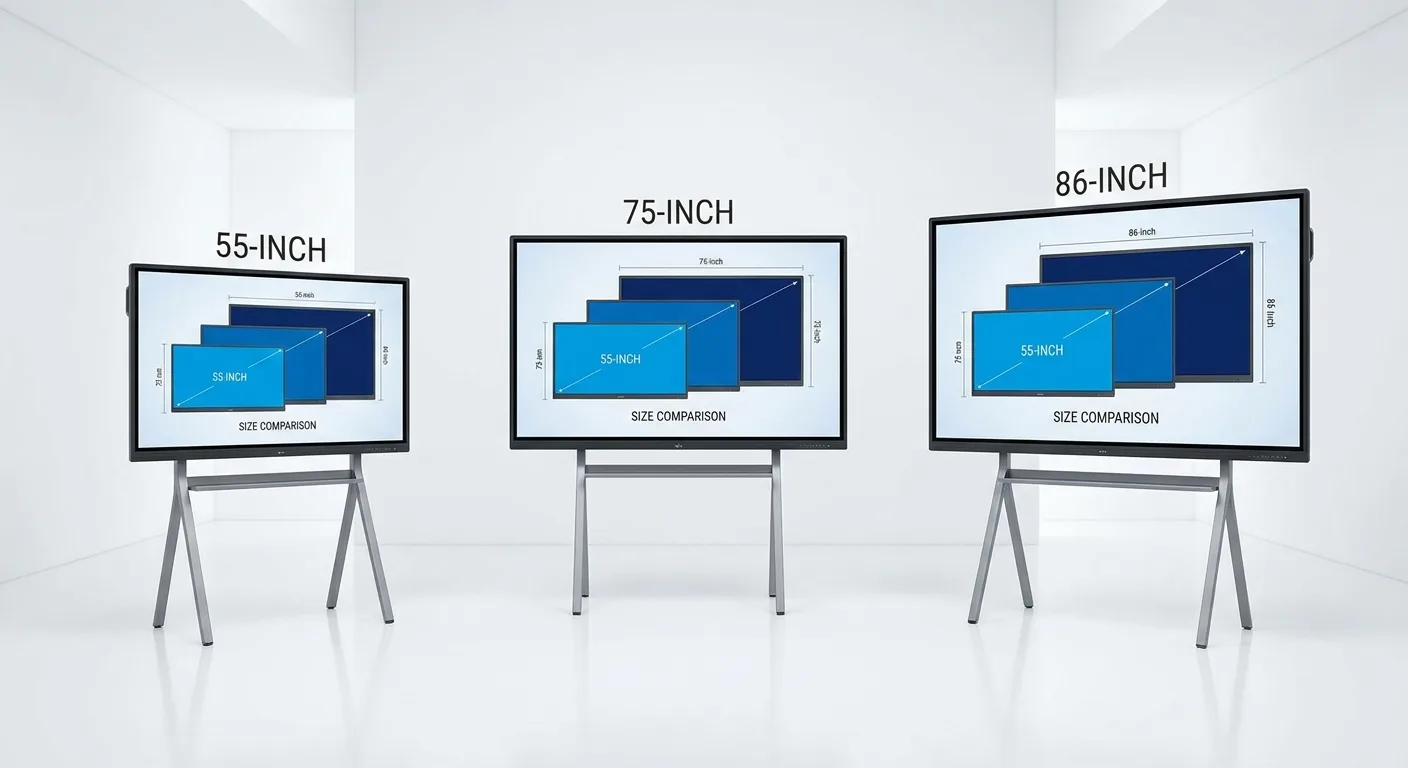
The Samsung Flip is ideal for university seminar rooms, research labs, and collaboration spaces. Its intuitive touch interface with S-Pen support makes it natural for academic discussions, research presentations, and collaborative problem-solving. The 75-inch and 85-inch Flip models are large enough for groups of 20 to 30 students, and the built-in whiteboard with Samsung Notes integration allows faculty to save and share session notes digitally. For engineering and design programmes, the Flip's colour accuracy and 4K resolution ensure that technical diagrams, CAD drawings, and visual content are rendered with precision.
Samsung QEC Series for Lecture Theaters
Large university lecture theaters (100+ seats) need high brightness and large display area. The Samsung QEC Series with 85-inch panels, higher brightness (350+ nits), and UHD resolution serves these environments well. For very large lecture halls, multiple QEC panels can be deployed side by side, or a QEC panel can be combined with a Samsung LED video wall for immersive lecture experiences. Universities like IIT Bombay, IIT Delhi, IIM Ahmedabad, and BITS Pilani have deployed Samsung commercial displays in lecture theaters and seminar rooms, leveraging Samsung's Knox MDM for centralized management across campus.
Hybrid Learning Readiness
NEP 2020 emphasises blended learning — combining in-person and online instruction. Both MAXHUB and Samsung IFPDs support this through built-in or external cameras and microphones for live streaming lectures, screen sharing for remote students via platforms like Google Meet and Microsoft Teams, and recording capabilities for creating lecture archives. Universities that invested in IFPDs during the post-COVID period are now finding these same devices essential for their ongoing hybrid teaching programmes.
How to Procure IFPDs for Indian Schools
Procurement is often the most complex part of a smart classroom deployment, especially for government and government-aided schools. Understanding the available procurement channels and their requirements helps school administrators and integrators navigate the process efficiently.
Government e-Marketplace (GeM)
GeM is the mandatory procurement platform for central government institutions and is increasingly adopted by state governments. Both MAXHUB and Samsung IFPDs are listed on GeM by authorized sellers. The GeM procurement process supports direct purchase (for orders under INR 25,000), L1 bidding (for orders up to INR 5 lakhs), and formal bid/RA (Reverse Auction) for larger procurements. Government schools, KVs, JNVs, and state-run educational institutions should procure through GeM to ensure compliance, competitive pricing, and documented authorization. Achyutam Corporate supports GeM-listed procurement with proper OEM authorization documentation and competitive pricing.
Private School Procurement
Private schools (CBSE, ICSE, IB, and state board) typically procure through direct quotation from authorized distributors or through AV system integrators. The key requirements are OEM authorization certificates (to verify the products are genuine and warranty-backed), GST-compliant invoicing, and a clear warranty and support commitment. Private schools deploying IFPDs across multiple classrooms should request volume pricing — the per-unit cost decreases significantly at 10+, 20+, and 50+ unit volumes. Achyutam Corporate provides direct quotations to private schools with volume-based pricing and optional extended warranty options.
Multi-Classroom Rollout Planning
Deploying IFPDs across 20, 50, or 100 classrooms requires careful planning beyond just purchasing the hardware. Consider these factors for a successful rollout: electrical infrastructure (each IFPD requires a dedicated power socket with earthing — verify that every classroom has this), mounting (wall-mount brackets must be installed on structural walls capable of supporting 40-80 kg depending on IFPD size), network connectivity (Ethernet or Wi-Fi to each classroom for online content and remote management), teacher training (budget for at least one full-day training session per teacher — the technology is useless if teachers are not comfortable using it), and content strategy (align digital content with the school's specific curriculum — CBSE, ICSE, or state board).
Budget Planning for Schools
A realistic per-classroom budget for a complete smart classroom setup (IFPD + OPS module + mounting + installation + basic training) ranges from INR 1.5 lakhs to INR 3.5 lakhs depending on IFPD size, brand, and installation complexity. The 75-inch MAXHUB EC Series — the most commonly deployed configuration in Indian government schools — typically falls in the INR 1.8 to 2.5 lakh range per classroom including installation. Samsung Flip and QEC configurations for universities are higher, typically INR 2.5 to 4 lakhs per room. These figures include the IFPD, OPS module, wall mount, installation, and basic teacher orientation but exclude network infrastructure and ongoing content subscriptions.