Samsung Hospitality TV vs Consumer TV — Why Indian Hotels Need Commercial-Grade Displays
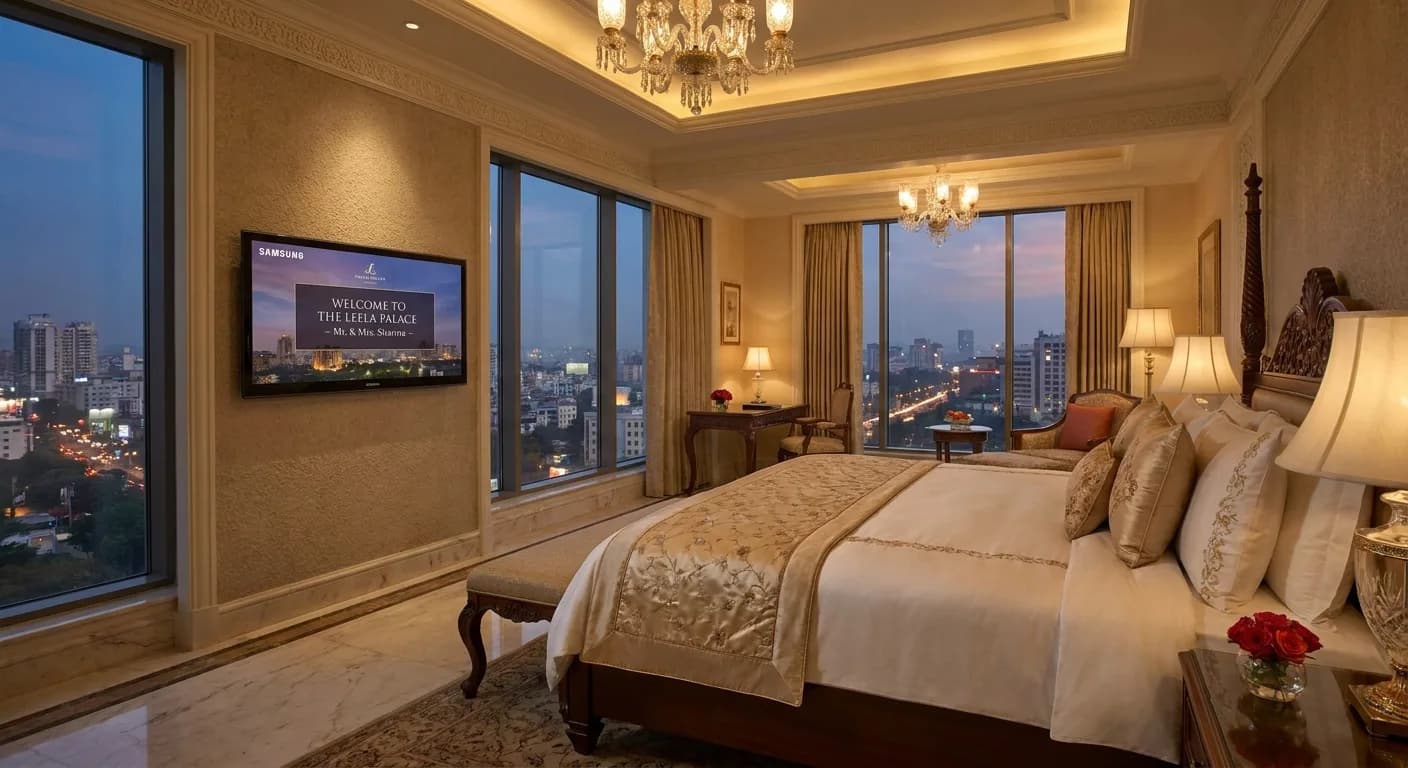
India's hospitality industry is expanding rapidly. New hotel properties — from budget chains like OYO and Lemon Tree to luxury brands like Taj, Oberoi, ITC, and Marriott — are opening across Tier 1, Tier 2, and even Tier 3 cities. Every hotel room needs a television, and the procurement decision between consumer-grade TVs and commercial hospitality displays has significant long-term consequences for guest experience, operational efficiency, and total cost of ownership.
The reality is that many Indian hotels — especially in the mid-market and budget segments — still install consumer televisions in guest rooms. This appears to save money at the point of purchase. But within months, the hidden costs start accumulating: guest complaints about inconsistent channel lineups, staff time spent resetting TVs that guests have reconfigured, displays failing prematurely because they are not rated for commercial operating hours, and the inability to deliver the branded, controlled guest experience that differentiates a professional hotel from a guesthouse.
This guide explains exactly why hospitality TVs exist, what they do that consumer TVs cannot, and how Samsung's hospitality range addresses the specific needs of the Indian hotel market.
Hospitality TV vs Consumer TV — At a Glance
The differences between a hospitality TV and a consumer TV go far beyond build quality. They are fundamentally different products designed for fundamentally different use cases. Here is the feature-by-feature comparison.
Hospitality TV vs Consumer TV Comparison
| Feature | Hospitality TV | Consumer TV |
|---|---|---|
| IPTV Integration | Native support via LYNK | Not supported |
| Welcome Screen | Branded with guest name (PMS) | Not available |
| Admin Lock | Full — guests cannot change settings | None — full guest access |
| Operating Hours Rating | 18-24 hours/day | 8-12 hours/day |
| Commercial Warranty | 3-year commercial | 1-year consumer (voided in commercial use) |
| Remote Management | LYNK Cloud / REACH | Not available |
| Channel Lineup Control | Centrally managed | Guest-configurable |
| Cloning / Mass Config | USB cloning across all rooms | Manual per-unit setup |
| OTT App Control | Curated, locked app list | Full app store access |
| Pillow Speaker / AUX | Supported (accessibility) | Not supported |
Why Each Feature Matters for Hotels
IPTV Integration
IPTV (Internet Protocol Television) is the modern standard for delivering TV content in hotels. Instead of running coaxial cable to every room, IPTV delivers live TV channels, on-demand content, and interactive hotel services over the existing Ethernet or Wi-Fi network. Samsung hospitality TVs include native IPTV client support through Samsung LYNK, which means they connect directly to the hotel's IPTV headend without requiring external set-top boxes. This eliminates the cost of a separate set-top box per room (typically INR 3,000 to 8,000 per unit), reduces points of failure, simplifies the in-room technology stack, and creates a cleaner aesthetic. Consumer TVs have no IPTV client capability — they require an external set-top box for every room, adding cost, complexity, and potential failure points.
Guest Experience and Welcome Screens
When a guest checks in and enters their room, the TV can display a personalised welcome message: “Welcome, Mr. Sharma” along with the hotel logo, Wi-Fi password, breakfast timings, and local weather. This integration works through the hotel's Property Management System (PMS) — when the front desk checks in a guest, the PMS sends the guest name and room number to the IPTV system, which pushes the personalised welcome screen to that specific room's TV. This level of personalisation is standard in premium hotels worldwide and is a tangible differentiator in guest satisfaction scores. Consumer TVs cannot do this. They power on to their default home screen — Samsung's Smart Hub or whatever the guest last left it on — creating an inconsistent, unbranded experience.
Admin Lock and Configuration Control
The admin lock is perhaps the most operationally critical feature of a hospitality TV. It prevents guests from accessing the TV's settings menu, changing the input source, modifying the channel lineup, connecting their own devices via Bluetooth, resetting the TV to factory defaults, or accessing features that the hotel does not want exposed. Without admin lock, every guest checkout becomes a potential TV reset scenario. Housekeeping staff cannot reliably reset a consumer TV to the hotel's desired state, which means the next guest may encounter a TV tuned to an unknown channel, connected to the previous guest's Bluetooth device, or displaying an unfamiliar language. Over a 100-room hotel with daily turnover, this creates dozens of guest complaints per week and consumes significant housekeeping and maintenance staff time.
Commercial Warranty and Durability
Hotel room TVs operate in harsh conditions. They run for 18 or more hours per day (guests leave them on), they are subject to voltage fluctuations common in Indian power infrastructure, and they endure daily housekeeping with cleaning agents that may not be appropriate for consumer electronics. Samsung hospitality TVs are built for this environment: commercial-grade power supplies handle voltage fluctuations, the panels are rated for extended operating hours, and the warranty covers commercial use for 3 years. Consumer Samsung TVs carry a 1-year warranty that explicitly covers domestic use only. Samsung India can deny warranty claims on consumer TVs installed in commercial settings — and they do. A single failed 55-inch consumer TV replacement costs INR 25,000 to 40,000, which eliminates any per-unit savings from buying consumer over hospitality.
Total Cost of Ownership — 50-Room Hotel Scenario
The per-unit price difference between hospitality and consumer TVs is real — Samsung hospitality TVs cost approximately 20 to 40 percent more per unit. But total cost of ownership (TCO) over a 5-year hotel lifecycle tells a dramatically different story. Let us walk through a realistic 50-room hotel scenario.
5-Year TCO: 50-Room Hotel (43" TVs)
| Cost Component | Hospitality TV | Consumer TV |
|---|---|---|
| Unit cost (x50) | INR 18-22 lakhs | INR 12-15 lakhs |
| Set-top boxes (IPTV) | INR 0 (built-in) | INR 2-4 lakhs |
| Replacements (5 yr est.) | 2-3 units (INR 0.7-1 lakh) | 8-12 units (INR 2-4 lakhs) |
| Staff time (resets/fixes) | Minimal — remote managed | Significant — manual per-room |
| Guest complaint impact | Low — consistent experience | High — inconsistent, branded risk |
| Estimated 5-yr TCO | INR 20-24 lakhs | INR 18-25 lakhs |
The numbers are clear: when you factor in set-top box elimination, lower replacement rates, reduced staff intervention, and improved guest satisfaction, hospitality TVs cost roughly the same — and often less — than consumer TVs over a 5-year period. The operational advantages (remote management, admin lock, branded experience) come essentially for free in the total cost picture.
The Hidden Cost of Guest Complaints
Guest satisfaction scores directly affect hotel revenue through online reviews and repeat bookings. A consistent, branded in-room entertainment experience is a baseline expectation in 2025. Hotels using consumer TVs with inconsistent channel lineups, exposed Smart TV menus, and missing IPTV functionality consistently score lower on the “room amenities” category in guest feedback. This revenue impact is difficult to quantify precisely but is consistently cited by hotel operations managers as a significant factor in the decision to upgrade to hospitality displays.
Samsung HE & HG Series Overview
Samsung's hospitality TV range is divided into two primary series, each targeting different segments of the hotel market.
HE Series — Standard Hospitality
The Samsung HE Series is the entry point for commercial hospitality displays. It includes all the essential hospitality features: LYNK REACH compatibility for remote management, admin lock (Hotel Mode), USB cloning for mass configuration, and compatibility with major IPTV platforms. The HE Series is available in 32-inch, 43-inch, 50-inch, and 55-inch sizes, covering the range from compact budget rooms to standard double rooms. Panel quality is Samsung commercial grade with 4K UHD resolution on larger sizes. The HE Series is the right choice for mid-market hotels, business hotels, and budget chains like Lemon Tree, Ginger, and Ibis where reliability and centralized management are the priorities.
HG Series — Premium Hospitality
The Samsung HG Series is the premium tier, designed for luxury and upper-upscale hotels where guest experience standards are highest. In addition to all HE Series features, the HG Series offers Samsung LYNK Cloud for cloud-based remote management, higher brightness panels, premium design aesthetics (slimmer bezels, cleaner rear panel), and advanced PMS integration capabilities. The HG Series is available in 43-inch, 50-inch, 55-inch, and 65-inch sizes, with the larger sizes designed for suites and premium room categories. QLED variants offer quantum-dot enhanced colour accuracy for properties where visual quality is a brand differentiator. The HG Series is specified by Taj, Oberoi, ITC, Marriott, Hyatt, and other luxury brands operating in India.
How Hotel IPTV Works
Understanding the IPTV architecture helps hotel owners and procurement teams make informed decisions about the in-room entertainment infrastructure. Here is how a modern hotel IPTV system works end-to-end.
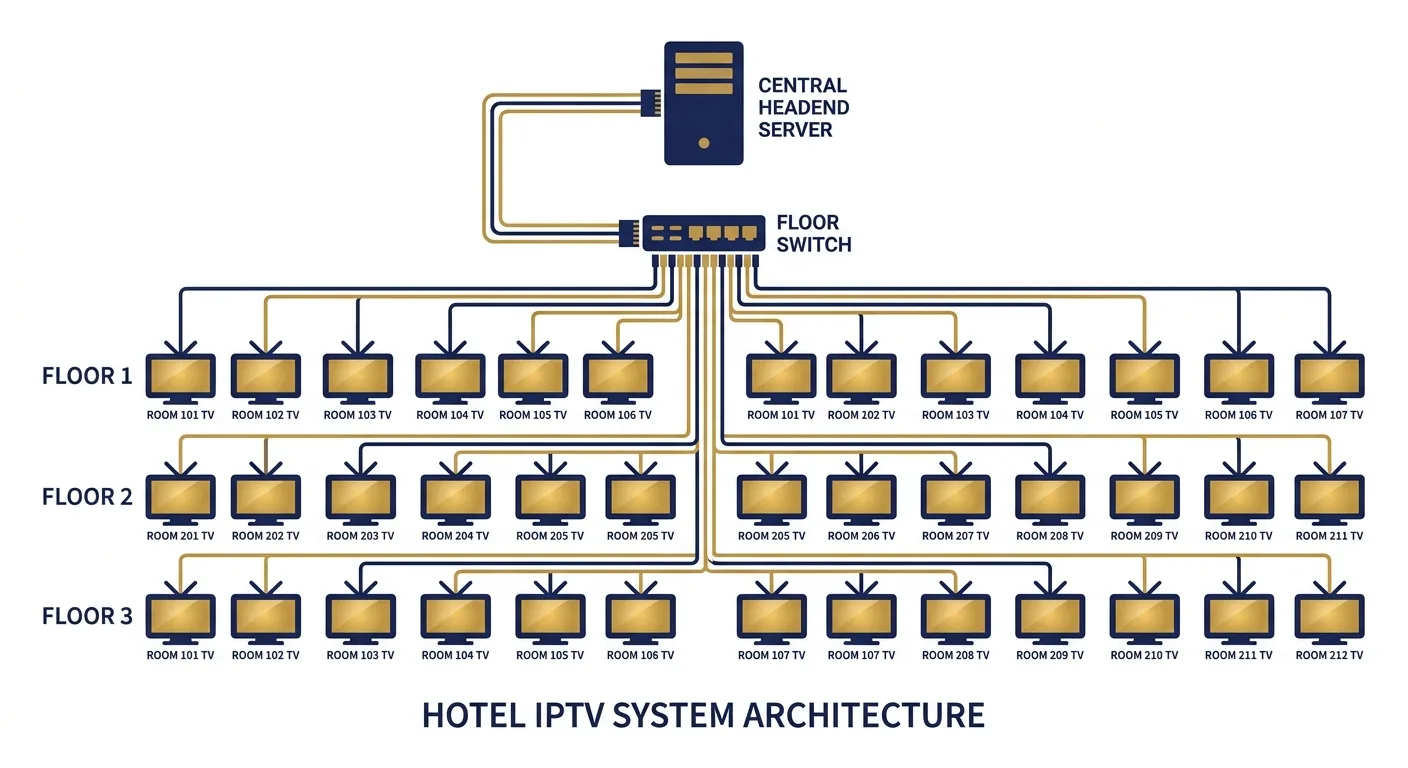
The IPTV Headend
The IPTV headend is the central server that receives live TV channels from satellite dishes, cable feeds, or terrestrial antennas. It transcodes these signals into IP streams (typically using H.264 or H.265 encoding) and multicast-distributes them over the hotel's IP network. The headend also hosts on-demand content, the electronic programme guide (EPG), and the interactive portal that guests see on their TV. Modern headend solutions from providers like Exterity, Tripleplay, and Alcatel-Lucent Enterprise are rack-mounted servers that fit in the hotel's server room alongside the network infrastructure.
Network Distribution
IPTV streams are delivered over the hotel's existing Ethernet network using multicast IP distribution. Each TV receives only the channel the guest is currently watching, which minimises bandwidth consumption. The network infrastructure must support IGMP snooping and multicast routing — features available on any commercial-grade managed switch. Hotels that have invested in structured cabling (Cat6 or better to every room) and managed PoE switches for Wi-Fi access points already have the network foundation for IPTV. The incremental network investment is typically minimal.
PMS Integration
Property Management System (PMS) integration is what transforms a hotel TV from a passive entertainment device into an interactive guest service platform. When the front desk checks in a guest, the PMS (Opera, Protel, Hotelogix, or similar) sends the guest name, room number, and stay dates to the IPTV system. The IPTV system pushes a personalised welcome screen to that room's TV. During the stay, the guest can access hotel services (spa booking, room service, laundry) through the TV interface. At checkout, the guest can review their folio and complete express checkout directly from the TV. This integration requires Samsung LYNK-compatible IPTV middleware and a PMS with a supported API — both of which are standard in modern hotel technology stacks.
Casting and OTT in 2025
Guest expectations have evolved beyond linear TV. Modern hospitality IPTV systems support Chromecast-style casting (guests cast from their own devices to the room TV) and curated OTT app access (Netflix, YouTube, Hotstar). Samsung hospitality TVs support these features natively when paired with compatible IPTV middleware. The key advantage over consumer TVs is that the hotel retains central control: casting sessions auto-terminate at checkout, OTT app access is curated (no guest-installed apps), and the guest's personal account credentials are not stored on the TV after checkout.